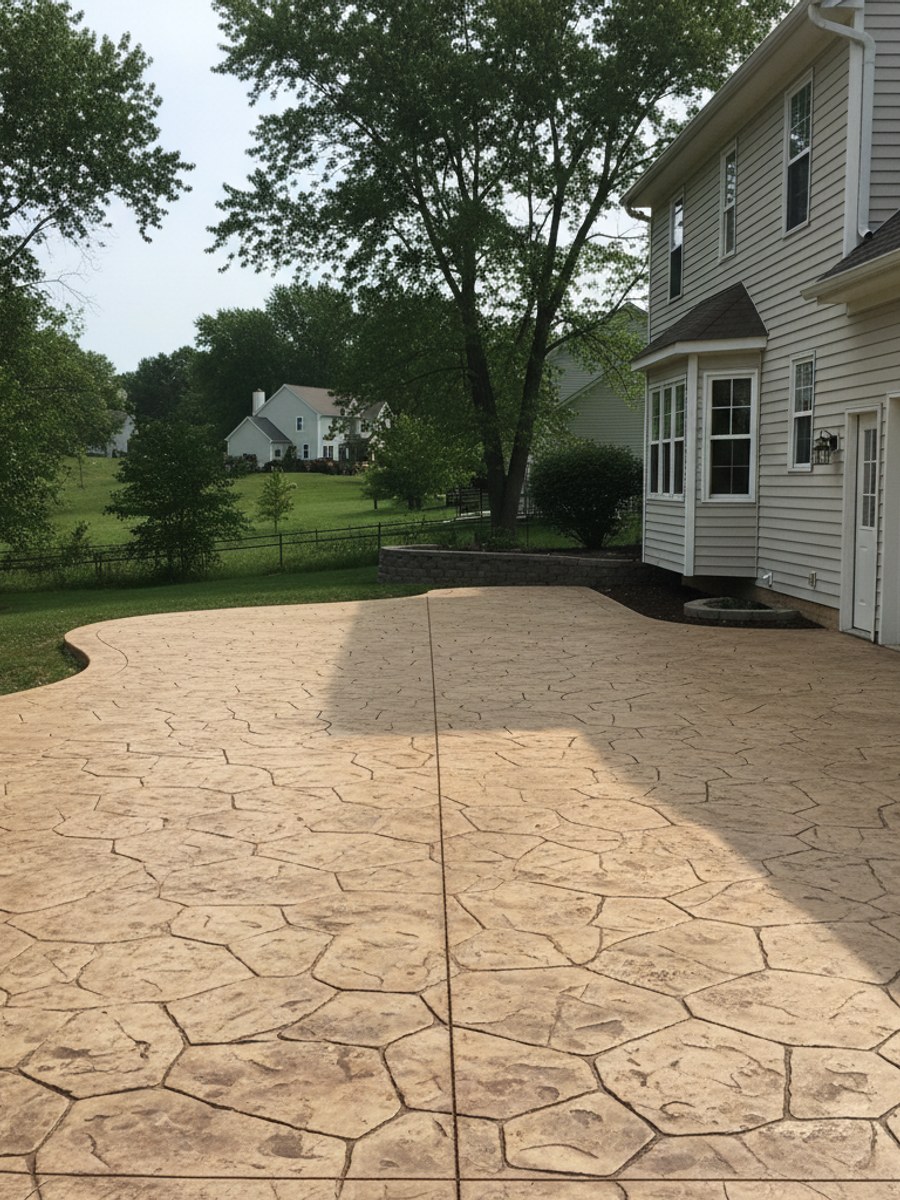
Concrete looks simple once it's poured and finished. Gray, flat, done. What you can't see is the six inches of gravel underneath it, the rebar or mesh inside it, and whether the guy who poured it knew what Clermont County clay does when it gets wet and then freezes. That's the part you're actually paying for, and it's the part most homeowners have no way to check once the truck leaves.
Ask what's going under the slab before you ask about price
Batavia sits on glacial till, which is a nice way of saying clay with rocks in it. That clay holds water, swells when it's wet, and shrinks when it dries out. A slab poured straight onto native clay with no compacted base underneath it will crack and heave within a couple of winters, no matter how good the concrete itself is. A contractor who knows the ground here will tell you, unprompted, that they're excavating down and putting in 4 to 6 inches of compacted gravel base before anything gets poured. If a contractor's answer to "what's under it" is a shrug or "we'll figure that out on site," that's your answer too.
Low spots and clay soil also mean drainage matters more here than in sandier parts of the state. If your lot slopes toward the house, or water pools near the East Fork side of a property after a heavy spring rain, the contractor should be talking about grading and slope before they're talking about stamped patterns or color.
Get the mix, the thickness, and the reinforcement in writing
Ohio gets real freeze-thaw cycles, often 30 to 40 a year between November and March. Concrete that isn't air-entrained, meaning it doesn't have tiny air bubbles mixed in to give freezing water somewhere to expand into, will spall and flake within a few winters. Exterior work here should be a 4,000 PSI mix with 5 to 7 percent air entrainment. That's not a preference, that's just what holds up to an Ohio winter.
Thickness matters too. A sidewalk or patio can get by at 4 inches. A driveway that's going to see a truck or an SUV every day needs 5 to 6 inches, and if you park anything heavier than that, ask about thickening the edges or adding rebar instead of just wire mesh, since mesh alone tends to sit at the bottom of the pour instead of doing its job in the middle of the slab. Ask for the mix design and the thickness in writing on the quote, not just "concrete driveway, $X."
Control joints matter more than people think. Concrete is going to crack somewhere, it's just a question of where. Joints cut every 8 to 10 feet, ideally within 24 hours of the pour, give it a place to crack that you won't see. Skip that step and you'll get a crack running diagonally across your new patio in a spot nobody wanted.
How permits actually work around here
Depending on where the property sits, you're either dealing with the Village of Batavia or Clermont County's building department, and a contractor who works here regularly should know which one applies without you having to explain your address. Driveway aprons that connect to a public street usually need a right-of-way permit, and any new footing, like for a garage slab, foundation, or a retaining wall over a few feet tall, typically gets a footing inspection before the pour and sometimes a final inspection after. If a wall is holding back a slope near a property line, a setback check is worth doing, especially on the older, tighter lots near downtown Batavia where houses and driveways sit closer together than in the newer subdivisions out toward Amelia or Union Township.
A contractor who pulls permits as a matter of course, and who doesn't flinch when you ask about it, is telling you something. One who says permits are "usually not needed" for a garage slab or a retaining wall is either wrong or hoping you won't check.
What the housing stock tells you
A lot of the older homes in and around Batavia village were built well before concrete driveways and sidewalks became standard, so what's in the ground on those lots is unpredictable. Old brick, buried clay drainage tile, sometimes an old cistern. Repair or replacement work on those properties takes more time up front for a reason, and a contractor should say so rather than quoting it like a blank slab. Newer subdivisions built from the 1990s on tend to have more consistent fill and grading, which usually means a more straightforward pour, but even there, builder-grade concrete from the original construction is often thinner and un-reinforced, which is why you'll see hairline cracks in 20-year-old driveways all over townships like Union and Batavia Township.
What to walk away from
- A quote with no thickness, no PSI, and no mention of base prep, just a price per square foot.
- Anyone offering to pour on a rainy day without covering the site or adjusting the schedule. Concrete poured too wet, or rained on before it's set up, cures weak.
- A cash-only price with no contract, especially for anything requiring a permit.
- No mention of curing time. You shouldn't walk on new concrete for at least 24 to 48 hours, shouldn't drive on it for about 7 days, and it isn't at full strength until around 28 days out. A contractor promising you can park a car on it the next day is cutting a corner somewhere.
- Nobody willing to show you a job they've done nearby that's a few years old, not brand new. New concrete always looks good. Three-year-old concrete tells you the truth.
None of this is complicated, it's just the stuff that doesn't show up in a glossy photo of a finished patio. Ask about the base, the mix, the joints, and the permit before you ask about the timeline. If you'd rather have someone walk your property and explain what your particular lot needs, that's the kind of conversation we have before we ever talk numbers at Neighborly Concrete Solutions.